Understanding the New KIDS COUNT Index Methodology
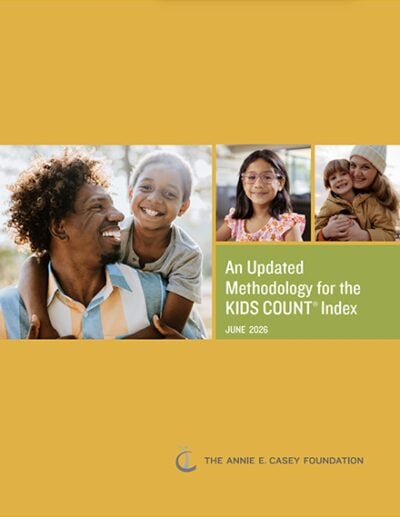
This publication explains how the Annie E. Casey Foundation updated the methodology behind the KIDS COUNT® Index — a trusted measure of child well-being across the United States. It walks through why the change was needed, how the new method works and what it means for policymakers, advocates and communities working to improve outcomes for kids.
For more than 35 years, KIDS COUNT has tracked how children are faring using data on economic well-being, education, health and family and community factors. This updated methodology builds on that legacy by adding new tools to better measure progress over time and differences between states — helping leaders identify where children are thriving and where more support is needed.
What’s New — And Why It Matters
The updated KIDS COUNT Index introduces a major shift: In addition to rankings, it now includes scores for each state overall and across four domains. Rankings remain useful for quick comparisons, but scores provide deeper insight into how much progress states have made — and how far they still have to go. This report outlines key improvements, including:
- a new scoring system that places states on a 0–1,000 scale, where higher scores reflect better outcomes for children;
- the ability to track changes over time, anchored to a 2019 baseline — the last full year of data before the COVID-19 pandemic;
- clearer insight into gaps between states and which areas (economic well-being, education, health, family and community) are driving results; and
- a more intuitive way to understand whether child well-being is improving or declining, beyond simple rank changes.
The shift addresses a key limitation of rankings alone: A state’s position can change even when outcomes do not. Scores help tell the fuller story by showing real progress, setbacks and the magnitude of differences between states.
How the Updated Methodology Works
The publication breaks down how the new index is calculated and why these changes improve clarity and usefulness. Readers will learn how the methodology has been updated to:
- continue to use 16 indicators across four domains: Economic Well-Being, Education, Health and Family and Community.
- apply a minimum to maximum transformation to standardize data, replacing the previous z-score approach.
- anchor all results to best and worst state outcomes in 2019, creating a consistent benchmark for measuring change.
- combine indicators into domain and overall scores using an equal weighting approach; and
- produce both rankings and scores, offering complementary ways to understand child well-being.
The report also explains why this approach is easier to interpret and better suited for tracking long-term trends, while still preserving the familiar rankings used in the KIDS COUNT Data Book.
What You’ll Learn From This Publication
By reading this report, you will:
- understand how the KIDS COUNT Index measures child well-being across states;
- see why the methodology was updated and how it improves on past approaches;
- learn how to interpret rankings vs. scores — and when to use each;
- explore how states can use data to measure progress, identify gaps and target resources;
- gain insight into how child well-being has changed since 2019, including the impacts of the pandemic; and
- discover how advocates and policymakers can use KIDS COUNT data to drive policy decisions and real-world change.
A Stronger Tool for Advancing Child Well-Being
This updated methodology makes the KIDS COUNT Index a more powerful tool for understanding how children are faring across states and over time. By combining rankings with meaningful, easy-to-interpret scores, the index now better captures progress, highlights disparities and supports smarter decision-making.
Ultimately, the expanded KIDS COUNT Index helps leaders, advocates and communities move beyond snapshots and toward a clearer, more complete picture of what children need to thrive and where action can make the greatest difference.