

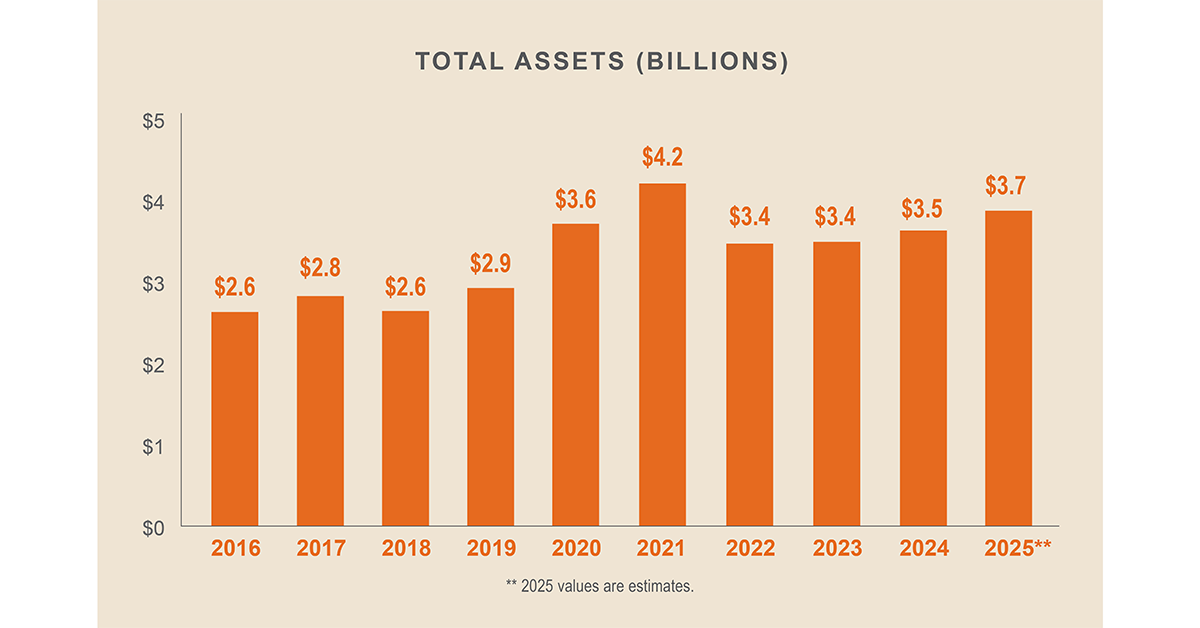
With assets of approximately $3.7 billion at the end of 2025, the Annie E. Casey Foundation, located in Baltimore, is among the largest private foundations in the United States.
The downloadable files contain the Audited Financial Statements for the Casey Foundation, including the Independent Auditors’ Report, Statement of Financial Positions, Statement of Activities, Statement of Cash Flows and Notes to the Financial Statements.
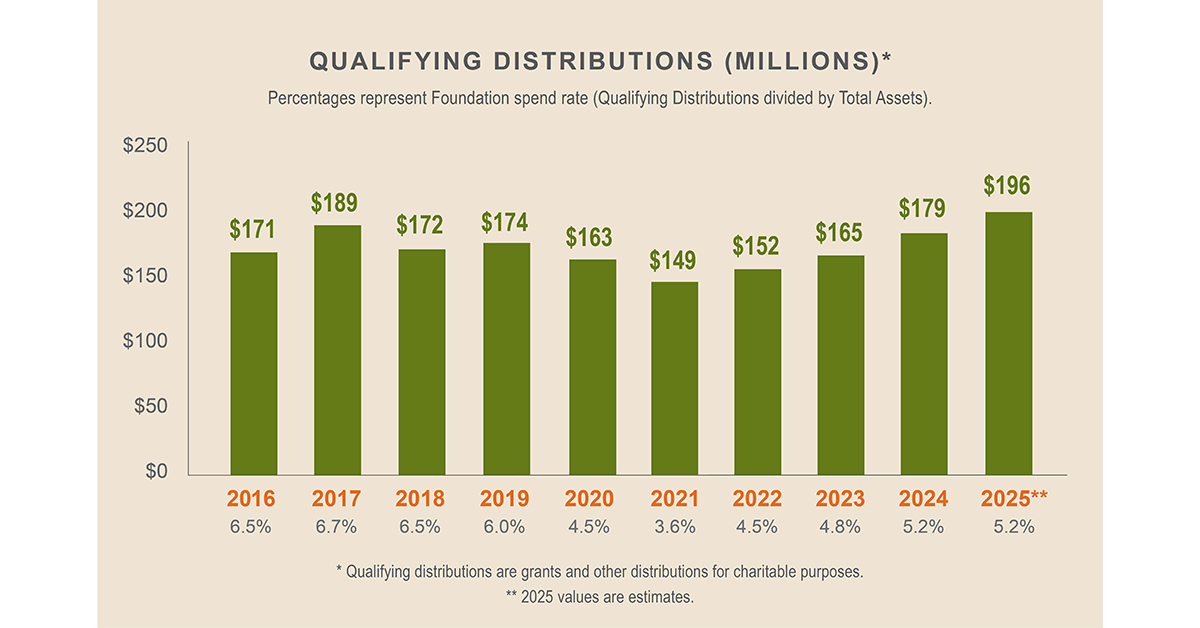
Below is information regarding the Foundation’s qualifying distributions and total assets for the past 10 years. These numbers are calculated based on the current tax rules and will differ from the Foundation’s financial statements.
The 990-PF is the tax return that private foundations file each year with the IRS. The 990-PF for the Foundation is posted on Guide Star and the Foundation Center websites. If you have questions or would like more information on how to interpret this document, please contact Katie Tetrault, vice president, Finance and Grants Management.
The Casey Foundation uses its resources in several connected ways to help children, young people, families and communities thrive. We invest in organizations, people, knowledge, public systems and practical tools that improve results for children and families.
Each year, Casey’s Board of Trustees sets a budget from the Foundation’s endowment using a formula designed to sustain its work over the long term. That matters because the challenges we focus on — including child welfare, juvenile justice, economic opportunity, education, basic needs and community leadership — require steady work over many years. The Foundation’s 2025 Annual Results Report describes five investment areas: basic needs; permanent relationships; financial stability; early care, education and credentials; and community and youth leadership.
Some private foundations, including the Casey Foundation, carry out their charitable missions through multiple investment vehicles. The IRS uses the term qualifying distributions for money used to accomplish charitable, educational, scientific or other public purposes. These distributions can include grants, impact investments and work a foundation does itself, rather than through a grantee. That can include staff salaries, travel and other operating costs when they are needed for the foundation’s charitable work and are reasonable in amount.
For Casey, charitable investments include grants, program-related investments, research, data, evaluation, technical assistance, leadership development, policy work, communications, convenings and direct work by staff and consultants with partners and public systems.
Most of the Foundation’s 200 staff are directly involved in mission work. They work with nonprofit leaders, advocates, researchers, policymakers and government officials to improve policies, strengthen practice and help effective ideas reach more children and families.
The Casey Foundation funds data collection and analysis, demonstration projects, evidence-based programs and practices, policy advocacy and analysis, research and evaluation, technical assistance, youth engagement and leadership development. Casey also invests in the effectiveness of nonprofit and government leaders, organizations and networks.
The annual KIDS COUNT Data Book and KIDS COUNT Data Center represent the Foundation’s long-running investment in analysis of public data about the well-being of children. The Data Book, produced for the past 37 years, gives policymakers, advocates, journalists, grantees and communities reliable national and state-level information on how children are doing. The 2026 edition tracks child well-being across four areas — economic well-being, education, health, and family and community — using 16 indicators, and it adds an enhanced index with rankings and scores to show how states compare and how conditions have changed since 2019. The KIDS COUNT Data Center draws on data from more than 53 state- and territory-based grantee organizations in the KIDS COUNT Network and houses hundreds of indicators and more than 4 million data points.
The Casey Foundation works with public child welfare agencies to help more children remain safely with family, relatives or trusted family friends whenever possible. The number of children and youth initially placed with relatives or close family friends when they entered the child welfare system had increased by 145% by 2025 across South Carolina and Maryland, where Foundation staff have been working with state officials since 2021 and 2022, respectively. South Carolina’s Teen Alternative Pathway Pilot, supported with technical assistance from Casey staff and consultants, offers crisis support, therapy and community-based services to help teens remain safely with their families and avoid foster care when possible.
In Maryland, the Foundation supported the Department of Human Services as it introduced streamlined licensing in December 2024 to make kin placements the preferred option for children who cannot remain safely at home. This work helps more relatives and trusted family friends become approved caregivers and access services and financial support.
Foundation staff worked with the state of Oklahoma in a multiyear effort to improve its foster care system. Oklahoma doubled the number of approved foster beds in three years through an effort to recruit and support foster parents, reduce reliance on shelters and group facilities and implement child safety meetings with families and communities.
The Foundation works with juvenile justice leaders, courts, probation departments, community organizations and young people to reduce unnecessary detention, keep more young people safely in their communities and improve how systems respond when young people get in trouble. Through the Juvenile Detention Alternatives Initiative® (JDAI), Casey staff and consultants work with a national network of juvenile justice practitioners and system stakeholders to reduce unnecessary detention and build safer, fairer youth justice systems. Casey provides technical assistance, learning labs, practice guides, implementation tools, convenings and online resources that help jurisdictions use data, collaboration and community-based alternatives to confinement.
Thirty jurisdictions have adopted the Casey Foundation’s approach to probation transformation, and among the 17 sites with complete data through 2024, out-of-home placements were down 41% since they began working with Casey. Across 73 sites participating in JDAI, detention admissions fell 17% from 2020 through 2025.
The Foundation reports qualifying distributions because they show the broader set of dollars used for charitable purposes. In 2025, Casey reported $196 million in qualifying distributions.
Casey makes financial and grant-making information public in several ways. The Annual Results Reports describes the Foundation’s priorities, investments and results. Visit Financial Information page to see audited financial reports and financial highlights. Casey also shares grant information through Candid.
We hope you'll find value in this report. We’d love to get a little information from you, which we'll use to notify you about relevant new resources.
