

Asian Americans United Provides Safe Haven for Philadelphia Youth
Asian Americans are the fastest-growing ethnic group in the country. The Foundation’s Race for Results report notes that children of Asian heritage in the United States make up about 5% of the total population of children, and that, overall, Asian Americans do relatively well compared to other non-white groups. In fact they often index higher than white kids.
For our reporting we went to Philadelphia, which has a very diverse Asian population — from Cambodians and Bhutanese to Chinese and Koreans — many of them recent immigrants or refugees. But contrary to the “model minority” myth, we discovered that Asian Americans are not universally well educated — Southeast Asians in Philly, for example, have rates of educational attainment similar to those of African Americans and Latinos and the number of unemployed Asian Americans in Philly has quadrupled between 2007 to 2011. During this same period the number of Asian Americans living below the poverty line grew 52% in Philadelphia.
There are stark differences between Asians born in the U.S. and immigrant families: 59% of U.S.–born Asian fourth graders were reading proficient and 65% of eighth graders were math proficient; among recent Asian immigrants, those numbers were only 15% in reading and 20% in math. Clearly, the degree to which young people are proficient in these skills has a major impact on their ability to find good paying jobs and careers. The children of Philadephia’s recent Asian immigrants often have difficulties communicating in English that limit their ability to access job opportunities. These kids often experience pressure to work while in school to supplement family incomes, and suffer a lack of support systems that recognize their cultural and linguistic barriers.
We connected with a nonprofit group in Philadelphia, Asian Americans United, which is making great strides addressing these problems. AAU’s Helen Gym told us how they group was formed in 1985 to really address issues of justice. “We fought around affordable housing, police brutality issues and educational justice.” The group responded to a lack of bilingual education in Philly’s public schools — and by rising rates of anti-Asian violence there — by forming their own charter school, where they also hold after-school programs for kids attending city schools.
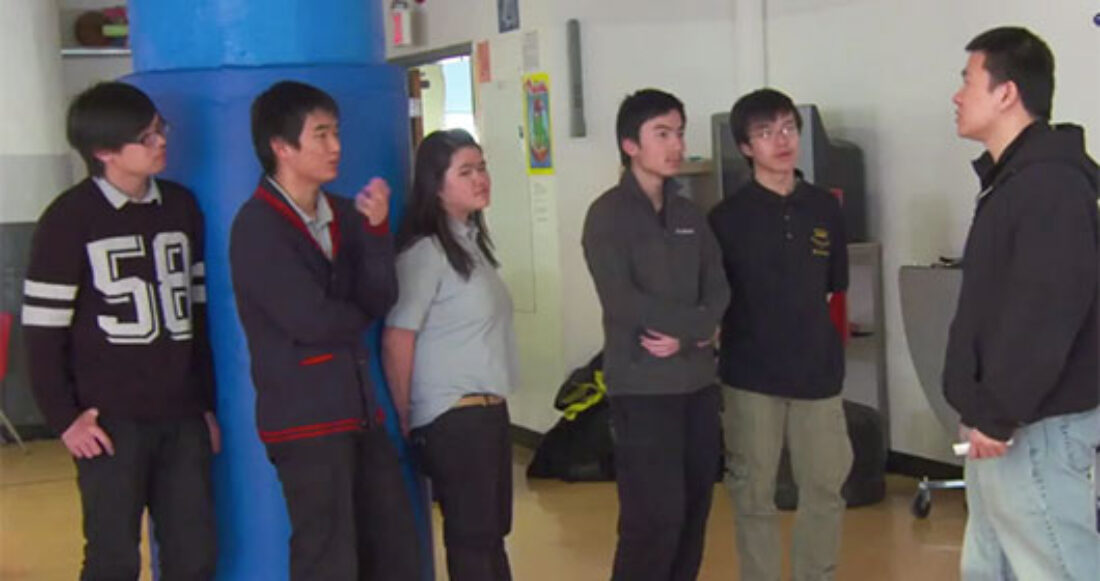
We filmed a meeting of their Community Youth Leadership Project, composed of recent Chinese immigrant kids, many of whom are employed in family-run restaurants whose jobs involve long hours. Tenth grade Minghang Chen describes working ‘til midnight after school several times a week. “It’s not really a job — it’s more I’m helping my parents, but I don’t want to depend on them, I don’t want their money — I want to learn skills to work outside my own job.” Because his parents never went to school in America, having emigrated from China, “they absolutely don’t understand me, or the hardship of learning English.” He speaks movingly about being ridiculed for his accent and feeling an outsider at school.
Vietnamese-born junior Van Sam began to cry when talking about how, in her home country, she was “really outgoing and funny, but here I shut down,” self-conscious about her accent. She’s also is very emotional about the growing culture gap between herself and her parents: “My father came here twenty years ago and he still doesn’t speak English. He goes to work in a factory at five AM and doesn’t return ‘til seven at night — completely isolated from life in America, really… He’s lonely, and doesn’t understand my life at all.” She tearfully admitted, “I feel I can’t do anything for him.”
Van’s friend Angela Zeng Spoke of the guilt imposed on her by her parents, who were disappointed when her grades lapses: “They get upset — they say ‘my life in China was good, but we came here for your education’… and make me feel like I’m not living up their high expectations.”
AAU is there to provide a safe place where youth can come build self-confidence, improve their job and language skills — and hold on to their native culture. “AAU is a place where I can share my feelings,” says Angela, “with other kids facing similar challenges. People are there to support you, and I feel like I’m growing a lot.” Most importantly, from AAU’s perspective, the program is helping form future community leaders. As Van Sam told us, “There are so many things that need to be fixed. If we don’t speak up, no one will fix it for us.”
This blog post and accompanying video were produced by Starfish Media Group and journalist Soledad O’Brien.