



What the Data Say About Young People and Gun Violence
 Tom Woods
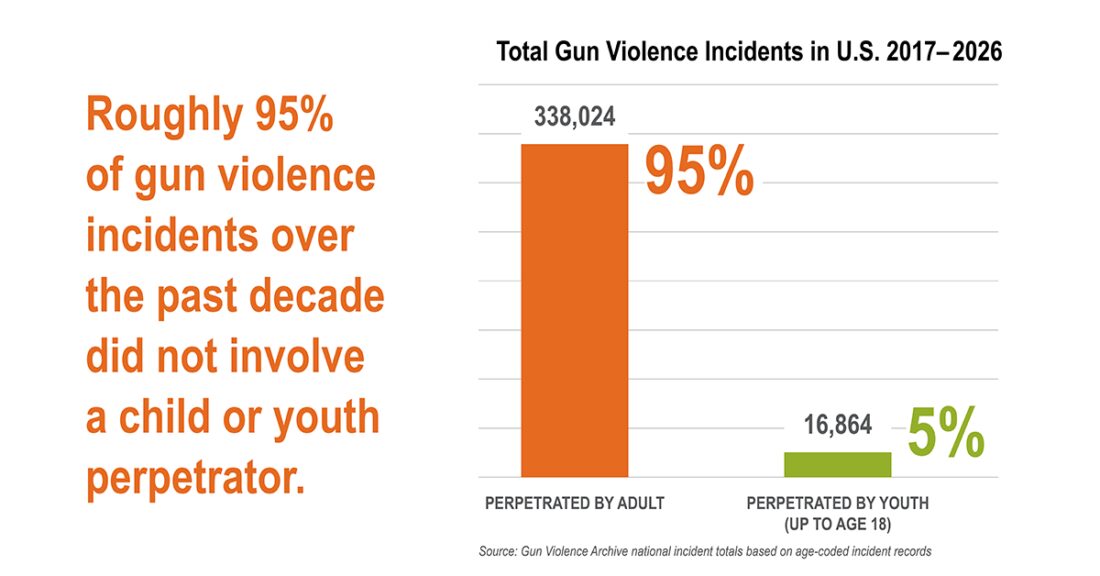
Source: Gun Violence Archive national incident totals based on age-coded incident records
Public conversations about young people and gun violence can be shaped by headlines, individual incidents and assumptions about youth crime. A new data dashboard offers another way to understand the issue: looking at the trends.
The Youth and Gun Violence Explorer, developed by Empact Solutions with support from the Annie E. Casey Foundation, allows users to explore trends in gun violence incidents that involve children and youth both as victims and as suspected perpetrators. Users can examine these trends at both national and state levels, with more fine-grained local perspectives to come. The dashboard draws on Gun Violence Archive data made available by The Trace and helps distinguish between young people who experience gun violence as victims and those involved as perpetrators.
Timely, relevant and localized data can help lead to better policies and decisions about young people — and push back against narratives about youth and gun violence that are misinformed or unsubstantiated.
Explore national and state-level trends in the youth and gun violence dashboard
These data enable us to challenge some common narratives about young people and violence. Four findings stand out.
1. Young People Experience Gun Violence More Often as Victims Than as Perpetrators
One of the clearest patterns is also an important one for understanding youth safety: Young people experience gun violence more often as victims than they are involved as perpetrators.
From 2017 through 2025, there were an average of 1.7 youth victims of gun violence for every 1 youth perpetrator, excluding incidents involving firearm possession alone.
This pattern persisted throughout the nine-year period. At the height of the increase in gun violence, which followed the COVID-19 pandemic, young people were more than twice as likely to experience gun violence as victims as they were to be involved as perpetrators.
Public discussions about young people and guns often focus on offenses committed by youth, framing gun violence as a problem of young people’s behavior. This misses the bigger picture:
Gun violence is, first and foremost, a threat to young people’s safety.
2. The Pandemic-Era Increase Affected Young People Most as Victims
During and in the wake of the COVID-19 pandemic, there was an increase in gun violence across society, and incidents involving young people increased significantly. But victimization and perpetration did not increase at the same rate.
The annual youth gun victimization rate, measured using a rolling 12-month average, roughly doubled from about 10 per 100,000 young people in February 2019 to more than 20 per 100,000 in June 2023.
Youth involvement as perpetrators also increased, but by a smaller amount. For every 100,000 youth, victimization increased by about 10 youth per year while perpetration increased by about three youth per year.
3. Youth Gun Violence Has Declined From Its Pandemic-Era Peak
The pandemic-era increase in gun violence among young people was heartbreaking, but it was not permanent.
Since peaking in 2023, both victimization and perpetration rates have fallen substantially. According to the most recent 12-month averages:
- Gun violence victimization among children from birth to age 11 has declined 41%.
- Gun violence perpetration involving children from birth to age 11 has declined 40%, excluding possession-only incidents.
- Gun violence victimization among youth ages 12 to 17 has declined 34%.
- Gun violence perpetration involving youth ages 12 to 17 has declined 19%, excluding possession-only incidents.
Any young person injured or killed by gun violence represents profound harm to families and communities. But understanding the direction of these trends is important for developing policies and practices based on current conditions. Against this backdrop, there current trends are encouraging.
4. Most Gun Violence Incidents Do Not Involve Children or Youth
The dashboard also places youth gun violence in the context of gun violence overall.
Across the 2017–2026 period examined, roughly 95% of gun violence incidents over the past decade did not involve a child or youth perpetrator. More than 85% of recorded gun violence incidents involved adults exclusively, and about 10% involved a child or youth as a victim. Only 5% involved a child or youth as a perpetrator, excluding possession-only incidents.
This means that efforts to reduce gun violence overall — and to protect young people in particular — cannot just focus on young people. Effective responses to gun violence must engage adults and communities as a whole.
Explore Data on Youth and Gun Violence in Your State
National statistics tell only part of the story. Trends can vary across states, making local data especially valuable for policymakers, youth justice leaders, community organizations and others working to keep young people safe.
The Youth and Gun Violence Explorer lets users examine the data by state and compare trends in victimization and perpetration over time. These data can help leaders ask better questions about what is happening in their communities and whether policies and resources reflect current conditions. For example: Are young people primarily experiencing gun violence as victims or perpetrators? Have those patterns changed? How does a state’s experience compare with national trends?
Search national and state-level trends in the Youth and Gun Violence Explorer
Learn more about the sources, methodology and considerations for interpreting the findings on the project’s “About the Data” page.