


A New Path Forward: Ten Ways to Transform Youth Justice

Across the country, youth justice systems are embracing change — rethinking how they support young people, families and communities. To help guide this transformation, the Annie E. Casey Foundation has launched Ten Ways to Transform Youth Justice, a suite of free, interactive tools designed to help local systems reflect, assess and improve.
Explore Ten Ways to Transform Youth Justice
These tools help communities evaluate how their youth justice systems are performing and identify clear, actionable steps to strengthen policy and practice. With a focus on collaboration and continuous improvement, Ten Ways helps practitioners seek better results for young people and the communities in which they live.
An Affirmative Vision of Youth Justice
Too often, traditional youth justice systems have emphasized surveillance, isolation and punishment. Though these systems often use the language of accountability, they can fall short of delivering its promise.
Ten Ways to Transform Youth Justice builds on the core principles of the Juvenile Detention Alternatives Initiative® (JDAI) — emphasizing healing over harm, support over sanctions and community over confinement.
“The standards and indicators that anchor this new tool were developed in collaboration with practitioners across the country,” said Danielle Lipow, a Casey senior associate. “They provide concrete, aspirational and practical benchmarks for youth justice systems determined to achieve the best possible outcomes for young people and their communities.”
Grounded in research and supported by curated resources, each standard reflects a key element of an effective and equitable system. While every jurisdiction starts from a different place, these benchmarks offer a shared vision — and a practical roadmap — for change.
Youth Justice Transformation Standards
The Ten Ways framework is organized around the following standards:
|
|
LEARN MORE ABOUT THE STANDARDS
The standards in Ten Ways do not provide an exhaustive set of benchmarks for detention or other youth justice institutions. For a comprehensive set of standards related to the operation of detention and other residential facilities, practitioners should use Ten Ways in conjunction with “Eight Principles to Transform Care” and the Juvenile Detention Facility Standards.
Self-Assessment and Customized Recommendations
Ten Ways invites users to engage in multiple ways:
- exploring standards and indicators;
- completing a self-assessment; or
- browsing a curated library of resources.
The self-assessment is designed for use by system practitioners, service providers, elected officials and community advocates — individually or in teams. Based on responses, users receive customized recommendations that identify opportunities for improvement and suggest clear next steps.
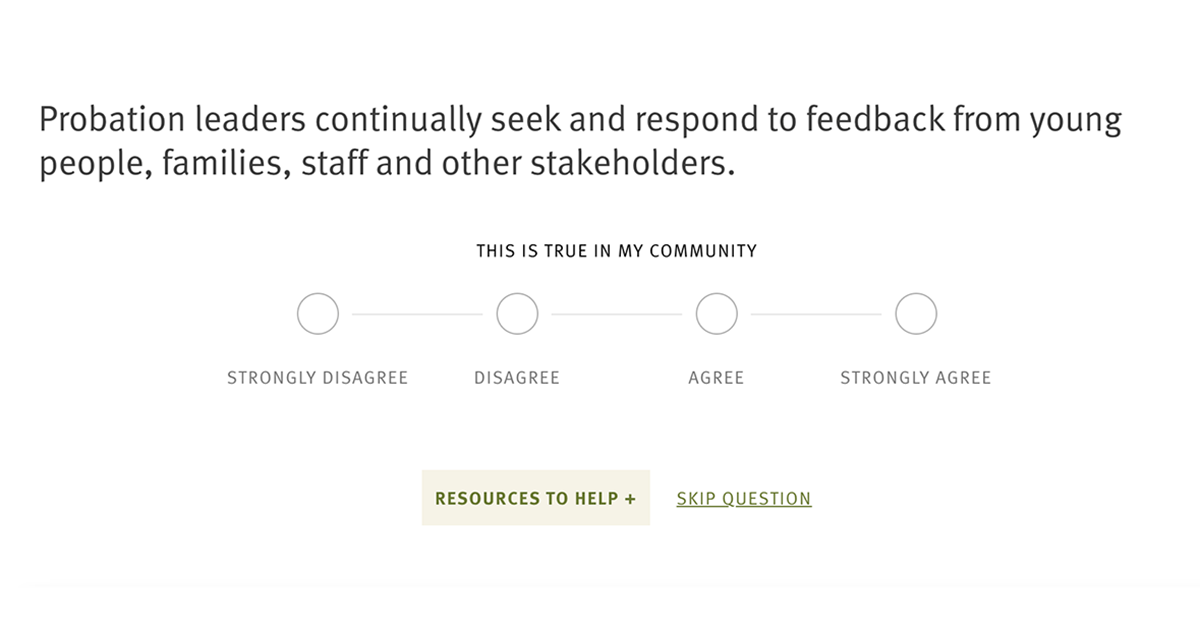
Users respond individually or as a team and receive recommendations tailored to their responses that identify opportunities for improvement and next steps.
“This tool underscores what judges increasingly recognize — that meaningful partnership with families and community organizations is essential to youth success,” said Marie Ward, chief judge of the Second Judicial District in Albuquerque, New Mexico. “It gives courts a clear framework for engaging those closest to young people and building responses that hold young people accountable in ways that support community safety and adolescent development.”
Next Steps to Transformation
The Ten Ways framework helps advance meaningful reform grounded in community, accountability and opportunity. While the work is ongoing, users are encouraged to take the next step.
“Ten Ways to Transform Youth Justice is designed to guide agencies’ next steps in strengthening their practice,” said Lipow. “We’ll be listening to user feedback to make sure it’s hitting its mark.”