

Grounded in research and shaped by insights from practitioners nationwide, each standard highlights a core element of an effective youth justice system. While every jurisdiction begins from a different place, the standards provide a shared vision — and a practical roadmap — for change.
Probation engages and partners with youth, families and communities, relying on community-based organizations as the primary vehicle for the delivery of services, support and interventions for young people.

Learn the value of connecting family members to peer mentors (sometimes called family advocates or family navigators) as a way to engage families as partners. (page 21)

Take this free online course to explore what authentic family engagement looks like, why it is a necessary part of probation transformation and what steps individuals and agencies — in partnership with families themselves — can take to bring it to life

Take this free online course to explore the core principles and practices of Positive Youth Justice, a strengths-based, relationship-focused approach to working with youth in the justice system.
The department’s policies and practices help ensure all young people can reach their potential.

Review a checklist offering 15 concrete steps that juvenile probation agencies can take to promote racial and ethnic equity and inclsuion. This checklist is excerpted from the Casey Foundation's 2018 publication on transforming juvenile probation.

Read about three strategies that are helping juvenile justice systems to safely and significantly reduce racial and ethnic disparities. (page 17)

Take this free online course to explore what it means to expand opportunity for all, including following data disaggregated by race and ethnicity to identify, understand and propose strategies to correct disparities.
Probation leadership aligns training, budgeting and planning with continuous improvement in transforming juvenile probation, repeatedly asking “how are we doing?” and “could we do it better?”

This tool is a starting point with deliberate questions that convey the depth and breadth of transforming juvenile probation. The tool also prompts frank discussions that should precede any formal efforts.
Take this free online course to learn how a department’s values and other aspects of organizational culture — including the broader system in which the department operates — can support probation transformation.

Watch videos and download tools that describe Results Count, the Annie E. Casey Foundation's approach to leadership development.
Probation leadership engages and supports staff as key actors in probation transformation.
Take this free online course to learn how a department’s values and other aspects of organizational culture — including the broader system in which the department operates — can support probation transformation.

Use the Casey Foundation's free Juvenile Probation Practice Survey and secure dashboard to gather information from probation officers, supervisors and leadership in 10 domains, including staff engagement, court conditions and family-centered practice. To date, more than 1,500 probation practitioners have taken the survey.

Fostering staff buy-in is important for any successful implementation effort. This fact sheet from the Urban Institute describes a range of research-based strategies for generating and sustaining staff enthusiasm in transformation.
Probation policy, practice and structure aim to minimize out-of-home placement and conserve probation resources for youth with serious charges who pose a significant risk to public safety.

Read the National Institute of Criminal Justice Reform's 2026 report that focuses on identifying and supporting the very small subset of young people in the juvenile justice system who are both high risk and hard to reach, often called HR2 youth.

See a summary from the National Council on Juvenile and Family Court Judges about why and how judges should consider probation for youth with serious offenses. (page 68)
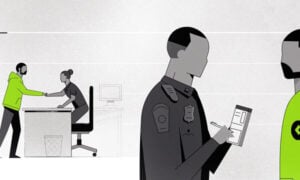
Learn how Roca, a community-based organization, pursues its mission to relentlessly disrupt violence by engaging young people, police and systems to heal trauma, find hope and drive change. Roca serves young people in three Northeastern jurisdictions and provides technical assistance and training throughout the country.
Law enforcement, prosecutors and the probation department partner with and direct adequate resources to local community-based organizations to steer young people away from the formal system and toward an array of community-led diversion options and services.

Explore an in-depth tool kit that offers principles and strategies for developing community-led diversion.

Read an "explainer" blog post about juvenile diversion, including resources, examples and frequently asked questions.

Watch CBS Minnesota's coverage of findings that youth whose first felony or gross misdemeanor cases were resolved through community accountability had half the risk of recidivism compared to similar cases in traditional court. The TV news story features a study by Kara Beckman and interviews Beckman and Ramsey County Attorney John Choi.
Probation is a time-limited, relationship-based intervention, with probation officers serving more as coaches than referees.
Learn the value of connecting family members to peer mentors (sometimes called family advocates or family navigators) as a way to engage families as partners. (page 21)
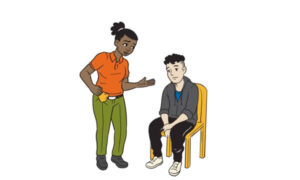
Watch a two-minute video presenting juvenile probation officer as coaches and catalysts for youth to succeed on probation and beyond. The coaching role aligns youth probation with powerful evidence on adolescent brain development, adolescent behavior and what works in addressing delinquent conduct.

Watch a five-minute video about ten core principles for youth probation, featuring Veronica Ballard Cunningham with the American Probation and Parole Association and Opal West with the Annie E. Casey Foundation.
Probation orders with standardized terms of probation have five or fewer conditions of probation.
View a sample probation order from the National Council of Juvenile and Family Court Judges. Annotations explain each provision. (page 48)

Browse a 50-state study and accompanying tool kit from the Council on State Governments, focused on how state laws and court rules can can shape the policies, culture and practices of juvenile probation condition setting and enforcement. Policymakers and system leaders can draw upon the findings to consider how their own state laws can best support effective probation practices.
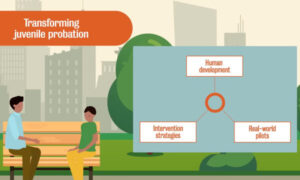
Watch a three-minute video that describes the vision for transforming juvenile probation. Viewers learn what works with young people to set them up for success as adults and effective ways to promote personal growth and positive behavior change in young people while still holding them accountable.
Detention is never used to respond to technical violations of probation.

Read the National Council on Juvenile and Family Court Judges guidance on alternatives to confinement in response to technical violations of probation. (page 51)
Review ten core probation principles identified by the American Probation and Parole Association that help young people desist from delinquent behavior and achieve long-term success.

Learn about six alternatives to youth incarceration that consistently produce better public safety outcomes than incarceration, with far less disruption to young people’s healthy adolescent development at a fraction of the cost.
The probation department relies on data for accountability and transparency, using data to continually assess practice and make improvements that enhance and promote probation transformation.
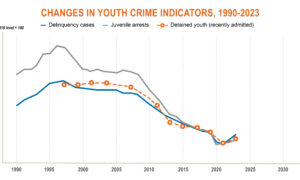
Youth crime is an addressable problem, according to Tom Woods, a senior associate at the Annie E. Casey Foundation. In a blog post for the Foundation’s website, he analyzes juvenile justice data over several decades and concludes that youth crime is trending downward. Woods cautions us not to conflate youth crime and violent crime. Violent crime is overwhelmingly an adult problem. Over decades of reducing youth crime, the field has learned a lot about what helps young people move forward to a safe, law-abiding, productive adulthood — and what holds them back. We don’t have to throw out that playbook. Rather, we need to recommit to doing more of what works and less of what doesn’t.

Start using Pro-DATA, a free resource created by the Annie E. Casey Foundation to support data-driven decision-making and data transparency in youth justice at the local and state levels. This secure, online tool makes it easy to collect and analyze your department's data, while also allowing comparisons to similar jurisdictions.

Explore a how-to guide about conducting focus groups with young people and their families. This guide was produced by Justice for Families, a family-led organization, and includes a facilitator's manual and other resources.
We hope you'll find value in this report. We’d love to get a little information from you, which we'll use to notify you about relevant new resources.
