


Law enforcement, prosecutors and the probation department partner with and direct adequate resources to local community-based organizations to steer young people away from the formal system and toward an array of community-led diversion options and services.

Explore an in-depth tool kit that offers principles and strategies for developing community-led diversion.

Read an "explainer" blog post about juvenile diversion, including resources, examples and frequently asked questions.

Watch CBS Minnesota's coverage of findings that youth whose first felony or gross misdemeanor cases were resolved through community accountability had half the risk of recidivism compared to similar cases in traditional court. The TV news story features a study by Kara Beckman and interviews Beckman and Ramsey County Attorney John Choi.
At least 60% of youth accused of delinquent conduct are diverted from juvenile probation, including all youth who do not pose a significant risk to public safety.
Get the facts on the benefits of diverting youth from the juvenile justice system and tools to implement diversion programs in your state. This five-part series is packed with research, concrete examples and testimonials from young people.

Review and share an infographic capturing the essentials of probation transformation.

Read coverage from Houston Public Media of the prosecutor's news conference about diverting nearly two-thirds of all young people accused of breaking the law.
Law enforcement and schools use alternatives-to-arrest for youth involved in disruptive behavior.

Watch a five-minute video explaining a collaboration between the Los Angeles Police Department and Centinela Youth Services, a community-based organization, to rely on restorative justice as an alternative to arrest. The video describes how restorative justice prioritizes victims' needs and safety.

Read a research-packed policy brief from the Sentencing Project that makes the case for diversion.

Read an opinion piece on diversion written by the director of juvenile justice at the Annie E. Casey Foundation. An excerpt: We all want a world where young people can realize their potential, even when they make mistakes. But that won’t be possible unless the legal system takes a back seat to families, schools and communities — in most cases — when young people push boundaries and break the law.

Read about a study by John Hopkins Medicine researchers concluding that police contact may be detrimental to the health and well-being of Black youth.
Following an arrest, prosecutors, probation departments and/or court-based intake staff have options to divert young people away from juvenile probation and toward community-based support, services and accountability.
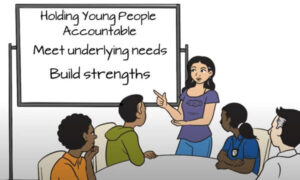
Watch a three-minute video about community-led diversion and development for youth who might otherwise face justice system involvement.
Review and share an infographic capturing the essentials of probation transformation.

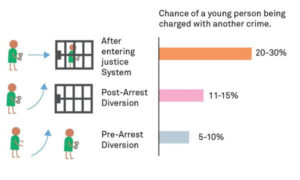
Read the University of Minnesota Medical School's evaluation of prosecutorial diversion over more than a decade in Ramsey County. The study found that just 4% of diverted youth reoffended within a year — compared to 29% of those processed in traditional court — and that youth facing assault charges had a 66% lower risk of recidivism when diverted to community accountability.

A University of Minnesota Medical School study found that successful pre-charge diversion produced the lowest recidivism rates of any prosecutorial response — just 12% of diverted youth reoffended within a year, compared to 47% of those who went through traditional court. The researchers concluded that recidivism increases with each additional legal system contact.
Youth have access to an array of diversion options, which may include simple warnings, restorative justice interventions and referrals for individual services.

This report from the National Conference of State Legislatures describes restorative justice models and approaches. Restorative justice is a policy area being examined as states continue to reexamine and rebalance approaches to juvenile justice policy.
Read about a collaboration among community-based organizations, young people, advocates and public systems to reimagine youth justice in Los Angeles County by steering young people away from the legal system and toward community-based services.

Read a diversion tool kit developed by the Ohio Supreme Court. An excerpt: The purpose of diversion is to redirect youth from involvement in the formal juvenile court system in an effort to hold youth accountable for their behavior without resorting to legal sanctions, court oversight, or the threat of confinement to mitigate future risk and subsequent delinquent behavior.

This Council of State Governments offers three key components states should consider for community-based service continuums. There is a checklist for states to assess, plan for and implement these continuums and sections for financing and policy strategies, among others.

Consider the research backing restorative justice as a safe and effective tool for diversion and accountability.
There is no informal probation (whereby youth diverted from formal court processing are overseen by probation officers and required to comply with probation conditions).

Consider the evidence against informal probation and explore developmentally appropriate alternatives.
Read this excerpt of an blog post by the Annie E. Casey Foundation that rejects practices such as placing diverted youth on informal probation caseloads.

Read a report examining the impact of informal probation in California and concluding that the practice runs counter to research, risks widening the net of youth involved in the justice system and erodes opportunities to invest in education and community development.

Read a 2018 news story in WitnessLA, "LA County Probation Planning To Shut Down Controversial ‘Probation Lite’ Youth Program," about the controversy over voluntary probation in Los Angeles County and the projected closure of the County's voluntary probation programs.
Diversion opportunities are not conditional (non-compliance doesn’t pull the youth back into the system).
Read a research-packed policy brief from the Sentencing Project that makes the case for diversion.
Read a one-page discussion of the promise and challenges of implementing diversion without conditions. Learn about the Santa Cruz Probation Department's approach. This is an excerpt from Transforming Juvenile Probation: A Vision for Getting It Right. (page 31)
We hope you'll find value in this report. We’d love to get a little information from you, which we'll use to notify you about relevant new resources.
