

Probation is a time-limited, relationship-based intervention, with probation officers serving more as coaches than referees.

Learn the value of connecting family members to peer mentors (sometimes called family advocates or family navigators) as a way to engage families as partners. (page 21)
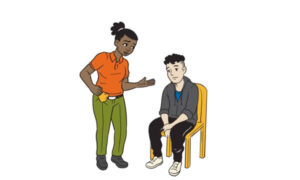
Watch a two-minute video presenting juvenile probation officer as coaches and catalysts for youth to succeed on probation and beyond. The coaching role aligns youth probation with powerful evidence on adolescent brain development, adolescent behavior and what works in addressing delinquent conduct.

Watch a five-minute video about ten core principles for youth probation, featuring Veronica Ballard Cunningham with the American Probation and Parole Association and Opal West with the Annie E. Casey Foundation.
Young people and families, defined broadly, are included in case planning.
Learn the value of connecting family members to peer mentors (sometimes called family advocates or family navigators) as a way to engage families as partners. (page 21)
This quick reference document prepares probation officers to meet with families to prepare or modify the case plan.

Take this free online course to explore the core principles and practices of Positive Youth Justice, a strengths-based, relationship-focused approach to working with youth in the justice system.
Case plans address identified needs, engage young people in positive youth development activities and contain realistic expectations and goals that are meaningful to young people and their families.
View sample case plans representing different stages of the family-engaged case planning process.
Learn the value of connecting family members to peer mentors (sometimes called family advocates or family navigators) as a way to engage families as partners. (page 21)

Learn how Positive Youth Justice builds on key principles of Positive Youth Development.

Read how Jeff Butts describes the Postive Youth Justice model, which offers practitioners concrete policies and procedures that align youth justice with the science of adolescent development.
The duration of probation supervision rarely exceeds six to nine months, and almost never exceeds one year.

Urban Institute proposes a structure and six-month timeline for time-limited, community-centered probation: phase one is for introductions, relationship building, assessment and planning; phase two is for connecting with long-term community support; phase three is for transition and safe closure. (page 19)
Case management prioritizes incentives to encourage positive behavior by offering opportunities and rewards valued by youth.

Read an overview of Opportunity-Based Probation, an approach that shifts probation's emphasis from deterring misbehavior to incentivizing positive behavior change and growth. (page 34)

Take this free online course to explore what is developmentally appropriate for young people based on the ongoing maturation process of the brain. The course offers important context for teen behavior and probation transformation.

Read the policy and procedure manual for Opportunity-Based Probation. It was designed by the Pierce County Juvenile Court in collaboration with the University of Washington.

Consider the evidence supporting the use of incentives as an essential component of good juvenile probation practice.
We hope you'll find value in this report. We’d love to get a little information from you, which we'll use to notify you about relevant new resources.
