


Adriana Galván and Lisa Lawson on Using Brain Science to Help Gen Z Thrive
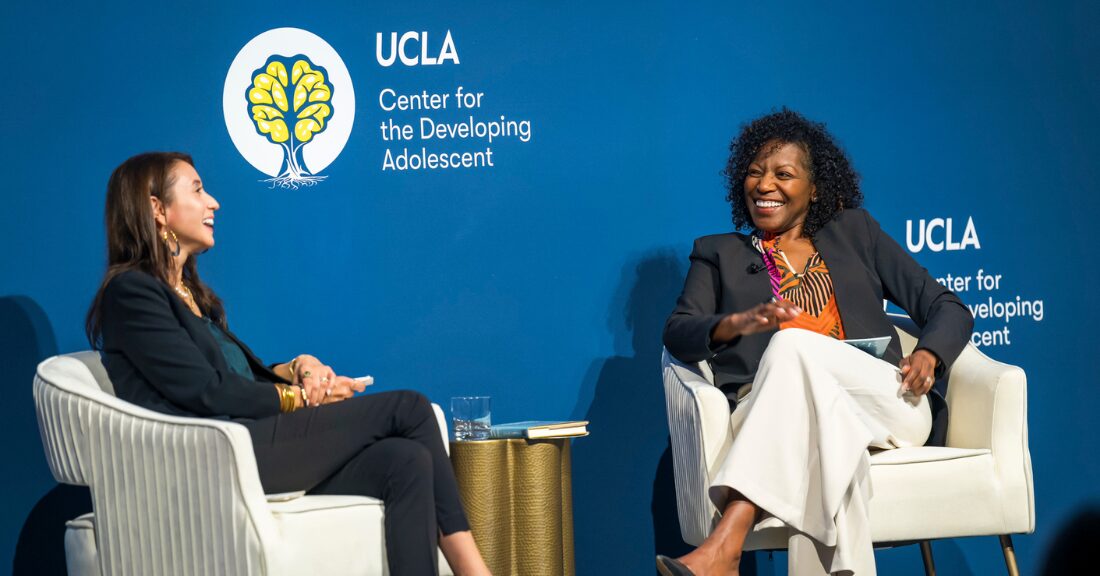
This episode of CaseyCast is adapted from a live conversation at the 2026 Adolescent Brain Development Summit hosted by the UCLA Center for the Developing Adolescent. Foundation President and CEO Lisa Lawson joined Adriana Galván for a fireside chat about how to better support young people as they navigate the path to adulthood.
The conversation follows Lisa’s keynote speech on the “bridge” young people cross during adolescence — a critical period of growth, shaped by brain development, experiences and environment. Drawing on insights from her book Thrive: How the Science of the Adolescent Brain Helps Us Imagine a Better Future for All Children, Lisa emphasizes that successful transitions to adulthood don’t happen by chance; they are built through intentional support, opportunities and relationships with caring adults.
Key Themes From the Conversation
- Adolescence is different from previous generations: Today’s youth are navigating a more complex path to adulthood, shaped by COVID-19-era disrupted schooling and social disconnection, the emergence of artificial intelligence and the rising cost of living. This means they need new skills like adaptability, problem-solving and resilience as well as stronger support systems.
- Meeting basic needs is a foundation for success: Without stable access to food, housing and financial support, it is difficult to focus& on education or work. Systems must make public benefits easier to access — especially for college students and young parents — and ensure young people have help navigating those systems.
- Centering youth voice and leadership: Young people bring insight and creativity to program design and decision-making. Whether through advisory councils, peer leadership or participatory research, adults should include them in designing the programs and systems meant to support them.
- Reframing risk-taking as a positive: Adolescence is a time of exploration and risk-taking. Although often framed as negative, young people’s willingness to try new ideas drives growth, learning and innovation.
- Mental health supports are essential: A mental health crisis, worsened by the pandemic, is affecting youth nationwide. Schools, workforce programs and public systems must embed mental health supports into everyday practices — not offer them as separate or optional.
- Challenging stereotypes and building intergenerational partnerships: Negative narratives about young people can undermine their confidence and access to opportunities. Instead, adults should listen, show respect and partner with young people, recognizing their strengths while helping them navigate new environments like the workplace.
Why Strengthening the Bridge to Adulthood Matters
Young people don’t reach adulthood by accident; they get there through the opportunities, relationships and systems that help them grow.
Investing in basic needs, expanding access to opportunities and elevating youth voice lead to better outcomes in education, employment and well-being, while helping young people build the skills and confidence needed to succeed in a quickly evolving labor market and changing society.
Learn More
- Podcast: Adriana Galván on the Adolescent Brain, Stress and Systems that Support Young People
- New Book Shows Why Equipping Adolescents to Thrive Is Key to a Brighter Future
- The Stages of Adolescent Brain Development
Listen On
Adriana Galvan: It is my great, great pleasure to introduce Lisa Lawson. She's the president and CEO of the Annie E. Casey Foundation. You are in for a real treat. Lisa joined the Foundation in 2011 after a 14-year career at UPS, where she served in roles ranging from attorney, activist, to president of the UPS Foundation. That cross-sector experience in business and policy and philanthropy deeply informs how she approaches the work that we're going to hear about today. Since becoming Casey's president in 2019, Lisa has helped sharpen the foundation's focus on the places where children and families face the greatest barriers, particularly in the South and the Southwest. And she's pushed the organization to invest more intentionally in prevention so that families support receive support long before crisis hits. One of her most significant commitments has been directing half of Casey's grantmaking towards young people ages 14 to 24, an effort known by Thrive by 25. That work focuses on helping young people meet their basic needs, build strong relationships, gain meaningful work experience, and chart pathways to adulthood. So the theme of her initiative perfectly suits our discussions today. Lisa recently captured this vision in her book, Thrive: How the Science of the Adolescent Brain Helps Us Imagine a Better Future for All Children. It's grounded in developmental science, shaped by lived experience, and filled with practical ideas for how we can better support young people during this critical window of growth. Beyond her role at Casey, Lisa serves as chair of the board of the Federal Reserve Bank of Richmond, co-chairs Baltimore's Promise and leads the Skills and Talent Committee for the Greater Washington Partnership. All roles that reflect her commitment to expanding opportunity and strengthening the education-to-career pipeline. She brings a bold vision and the leadership experience to turn that vision into action, and we are delighted to have her here. Please join me in welcoming her.
Thank you, Lisa. I can see that you've done a lot of reading on the adolescent brain, informed by the work of a lot of people in this room.
Lisa Lawson: Yeah. Living through adolescence myself and raising an adolescent. And, you know, one of the most interesting things, as I've talked about the book, is that people understand adolescence through the lens, often, of being a parent.
Adriana Galvan: That's right, yeah.
Lisa Lawson: And that the more we help parents understand what's going on in adolescence, it really can inform how they lead and their other roles in life.
Adriana Galvan: And we also have a lot of anecdotes of what it was like for us to be adolescents, right? And sometimes those don't apply because maybe we didn't know as much about the developmental science of adolescence at that time.
Lisa Lawson: Right, right. So yeah, you— those funny pictures of me as an adolescent. You know, I'm a leader who doesn't have, you know, a hard journey to adulthood. I had a really wonderful childhood. We've talked about this.
Adriana Galvan: We've both loved adolescence.
Lisa Lawson: I had a great time. And I— now understand that it's because I had all these guardrails and all these opportunities, that my parents were fortunate to widen that pathway for me. So I was in literally every program that could have been created to help me explore work, to help me— you know, I was a music kid, so I played the flute. I was a ballet dancer. You know, I was like actively engaged in things that were helping me build confidence and explore my talents. And so—.
Adriana Galvan: And they were cheering you on.
Lisa Lawson: And they were cheering me on. And I— I just really want all young people to have that kind of experience because I'm not here by a mistake. I'm here by design.
Adriana Galvan: Right.
Lisa Lawson: And so I know how the things people poured into me can help create amazing other young leaders in the world.
Adriana Galvan: So how do you think adolescence has changed? I mean, we've talked about that a little bit before, but— and you mentioned it in your talk, but—.
Lisa Lawson: In so many ways. You know, I think sometimes adults are like, well, I made it across that bridge. Why do we need to do anything different? It's very different today. You know, when you think about— again, the pandemic was horrible for all of us as adults. But imagine being a young person and separated from your peers when that's such a developmentally important relationship-building time for them. Their school was interrupted. They're trying to learn through a screen. They didn't have opportunities for those first-time jobs, working as a lifeguard or working at the mall. All of that was shut down.
Adriana Galvan: And just to connect.
Lisa Lawson: And just to connect!
Adriana Galvan: It is so important to be able to connect.
Lisa Lawson: And so, that was stunted. And then you think about, you know, AI. All of us are working as hard as we can to try to figure out how it's going to change their job— you know, our jobs. It's changing school for them. They don't know what job to even try for because they don't know what might— you know, the jobs that they might have 10 years from now don't exist. And jobs that they're in school trying to learn the skills for now, you know, might not exist. So— and, you know, cost of living just goes up and up and up. We hear so much about, you know, how buying a home might be out of reach for the next generation. So, um, they need very— you know, they need a lot more flexible skills, a lot more agility if they're going to navigate the, the world to come, which is very different. I'm, you know, I majored in something and I could get a job in it and, you know, and seamlessly go into that for the next 20 years. That is not going to be their experience. So they're going to need a very different set of skills.
Adriana Galvan: Yeah. And also they need, I'm sure they hear us talking about it. They hear our anxieties about their generation. And so if we're providing the anxiety without the solution or the flexible skills that they need, we're not helping. We're just planting a seed of fear.
Lisa Lawson: And contributing to their anxiety, which they already have a lot of. And I often say, you know, young people can hear us. I think we talk a lot of times assuming they don't hear us talking negatively. I've never said the word teenager and somebody in the room didn't go, "Ugh." They see that. Like, they know that means that we don't like them or that we don't believe in them.
Adriana Galvan: And yet, we also send another message that we want to be them, right? We try to adopt their language and their hair and their fashion. And yet, we—.
Lisa Lawson: But then we demonize them. So yes, it is a very different bridge that they are crossing. And they're doing it often feeling like we're not with them, that we're not supporting them in the ways that—.
Adriana Galvan: So how do we create more of that stability? These better on-ramps that they need?
Lisa Lawson: No, you know, I think the first thing is that basic needs. We've got to do more to strengthen the safety net for young people. When we started doing this work, you know, there's lots of work on, you know, adults and how much adults get access to benefits. But interestingly, there hadn't been a lot of research done on young adults and how much they have access to benefits. And it was really pretty low because often they don't think it applies to them. And so we have massive issues with food insecurity among college students. And a quarter of college students are parents. And they just don't understand that those benefits we often talk about, you know, to food or to housing, apply to them. So I know you've got one of our grantees here, the Student Basic Needs Coalition, that is trying to address that issue and using peer mentoring, using peer navigators to help young people, particularly who are students, get access to those benefits. So that's just one way I think we've got to tailor our support systems and navigation to help young people get access to those basic needs. You talked about sort of what's different. Navigation is, I think, one of the most important things we've got to do because I think it's the universal solver for so many things, whether it's basic needs or education and workforce. The world is extraordinarily complex, and we've got to get more mentors and navigators equipped to help young people get through. And so even when it's peer navigation, it's just a great way to help them figure out how do I even apply for these benefits? Do they apply to me? How do I apply? How do I keep them?
Adriana Galvan: And that's responsive to what we know young people are really good at, which is bonding with other people, forming connections, asking their peers for help.
Lisa Lawson: And wanting purpose. And leadership opportunities.
Adriana Galvan: And wanting purpose, right. Yeah, we'll talk a little bit about that later. The program you mentioned, PAYA, which I think you mentioned is in Washington, I was— really reflecting on how important it is that you bolster what we know about their inherent responsibility to rewards and feedback. Can you say more about that program?
Lisa Lawson: That's the Opportunity Passport work that we do around juvenile justice. You know, there's just lots of conversation today about young people and crime. I wanted to level set the audience that this is not every young person. It's 48 million young people we're talking about, and they are not all creating negative communities for us. But we've been doing juvenile justice work for over 25 years. And this science has been used to help address sentencing for young people so that we understand what is developmentally appropriate. But that, you know, sort of the incarceration part is the small part of what happens. The big part of what happens is this probation. And we realized a number of years ago, we gotta do something to work on this probation situation because young people don't do well with this list of rules that's being given to them. And so that's how we leaned on the science and how can we create something that's more aligned with the science. And I don't think we even imagined it would be as successful as it was. And the adults who work in the system enjoy it more too because they aren't controlling young people. They are taught to be coaches.
Adriana Galvan: They're working with a receptive audience, right?
Lisa Lawson: They're taught to be coaches and to engage with young people in more positive ways. And they all say, I got into this work because I want to help young people. And if you give me the tools to help them better, I feel better about the job that I have. So it has really been transformative for the young people on probation and for the adults who are supporting them who now feel like they've got the science, the understanding, and the mechanism to better help young people get on track.
Adriana Galvan: And the tools to lead with respect. We know that adolescents and the adolescent brain is really tuned into who's showing them respect and signs of disrespect. So what are— what language can we use for signaling that to young people, that we respect them, and all of the programs that you've talked about?
Lisa Lawson: Listening. It is the simplest thing we can do. Young people love to be heard. This is a time where they're finding their voice. And in almost everything we do, we find a way to incorporate youth engagement in that work. In our juvenile justice work, we helped a number of facilities set up student councils for young people so that they could contribute to what would make this place safer? What would make this place help you dream? What would make this place enable you to connect? Or young people aging out of foster care. In our apprenticeship work, there's always some council or advisory group of young people. And every single time they tell us something that we missed, they tell us something we didn't think about, and they are extraordinarily creative. We see it every day.
Adriana Galvan: Well, that goes hand in hand with what you mentioned about risk-taking, that they're more comfortable with it. And being creative means putting yourself out on a limb, right? Right. Individuals in our communities who are creative and artists, they're always testing their ideas, knowing that some may land, some may not. That willingness to engage in the risk is something that our young people are inherently probably better able at doing than we are.
Lisa Lawson: That's the positive framing of risk-taking that we often think is about driving too fast in your Buick Skyhawk on the highway when it is really about being willing to just try different things and to put your ideas out there.
Adriana Galvan: What are the other forms of risk-taking that we often don't lift up?
Lisa Lawson: Wow.You know, even building relationships is a risk with other people, to try to meet different people in different spaces and figure out whether or not they are folks that you could connect with. Work is a risk. You know, when you go to work, you've got to be open to learning new skills. Got to be open to taking feedback, sometimes criticism of what you're doing.
Adriana Galvan: And you're often the youngest person in the room.
Lisa Lawson: You're often the youngest person in the room.
Adriana Galvan: And ageism is real. Oh, 100%.
Lisa Lawson: It goes both ways.
Adriana Galvan: Absolutely. Yeah, it does go both ways. It does.
Lisa Lawson: But, you know, the ways that we grow throughout our lives is through taking a risk to do something else. You know, it's a risk to be a tax lawyer and try to lead the foundation around you. You know, it is. And I do think it's during those times young people get to see the rewards of risk. And because of that, we become more willing to take risk as we get older as adults. But that risk-taking is often beyond your family of origin. And, you know, the risks that you take, you know, in your family are very different than risks you take in a workplace where there is— you don't know these people. And they don't necessarily have any interest in you. That's a big risk to do that in a space where you may or may not know how it will be received. You know, I think this is sort of my advice to all of us as we have young people joining the workforce, Generation Z, to really sit and listen with them, give them guidance about what are the norms in a particular workplace because it's a scary transition for them as they join a workforce that they know isn't always so keen on them.
Adriana Galvan: Yeah, what are some of the norms that may not be obvious to young people?
Lisa Lawson: You know, I admit as a leader, I was sort of frustrated with all the questions that young people ask. They have a need to understand why. And that's not a bad inclination. Like, aren't you going to do a better job if you understand the why behind what's going on? Many of us held our why inside when we were first joining the workforce. They put theirs out. And so, I respect that. Thank you for asking so that you have the right answer. I also learned they skip hierarchy. You know, they are more than— they will go to the president. Well, I need to talk to you about it. And I asked somebody, like, what is that about? It's because the world is flat for them. They grew up with social media. They can tweet the President of the United States. We didn't have that when we were growing up. The bridge is different. So they grew up without hierarchy in their lives, and so they think, well, I have a question, I need to go to the top. That's the person who knows the answer. So to help them understand, actually, the first person you ought to ask is your manager or your director, that's not their first inclination. So that's just a norm setting to help them understand.
Adriana Galvan: And very practical skill that would be helpful for everybody involved.
Lisa Lawson: Right. But you have to think about why they assume that. And it's just because their bridge is different than ours.
Adriana Galvan: So on the one hand, they seem more bold socially. And on the other hand, I always get questions about there's, you know, everybody's anxious and whatever it is. So how does that square?
Lisa Lawson: It's all true. Yeah. That's true.
Adriana Galvan: I mean, you can have both things are true.
Lisa Lawson: They can be complex individuals just the way we're complex individuals. I am an extrovert, but there are also times I don't wanna talk to people. You know.
Adriana Galvan: Yep, I'm the same way.
Lisa Lawson: You know, let them be full human beings with a range of emotions and a range of—.
Adriana Galvan: We put them in a box. We generalize.
Lisa Lawson: We do. We do. And nobody wants to be put in a box. I was talking to a group of women leaders, and I was like, you know, the things we say about young people, imagine in the '50s that this might have been the way people talked about women joining the workforce. They're gonna be too emotional. They care about purpose and these other things. Oh! Oh, you know, might be—.
Adriana Galvan: They're going to ruin everything.
Lisa Lawson: They're going to ruin everything. I'm a woman in the workplace. I wouldn't want somebody stereotyping me as I joined the workplace or defining me in a certain way. All that to say, stereotype's not a good thing for anybody at any age.
Adriana Galvan: Well, especially in this age group that spans so many years, right? Your initiative is 4 to 24—or not 4 to 24, 14 to 24. 14 to 24. You know, we say 10 to 25 or whatever it is. That's a long time.
Lisa Lawson: That's a long time. And you know, the thing I write in the book is that we have the longest adolescence of any animal. Baby seals, it's like maybe 10 weeks. You know, other animals—
Adriana Galvan: Wombats—
Lisa Lawson: You know, it's maybe a couple of months. It takes us 10 years to be human. And I think that's really fascinating about what adolescence is doing. It's actually giving us the capabilities—.
Adriana Galvan: That extra time.
Lisa Lawson: That extra time is what makes us human.
Adriana Galvan: And the time isn't just biological time, but it's experience, right? It’s feedback.
Lisa Lawson: Context.
Adriana Galvan: All of that time. Yeah, it's such a gift to have that much time to turn into the next stage of development that whatever your species is.
Lisa Lawson: Although they're different, you know, they're— at 18, yes, you're an adult and you can do certain things, but there's still more time needed for us to fully bake. I joke that when I was pregnant, I signed up for some email, the Parent Center, and they would tell you, "Your baby is a peanut." "Your baby is a mango." Here are all the things that are changing in your young person so you could see what was happening developmentally. Yeah, but no email showed up when my daughter turned 13. Um, and so, you know, maybe we need to institute that. The Center for Developing Adolescents.
Adriana Galvan: Yeah, that's our next project.
Lisa Lawson: Hey, your young person is this big and this is what is happening in their brain.
Adriana Galvan: They couldn't keep pace, right?
Lisa Lawson: They couldn’t.
Adriana Galvan: Yeah, my son— I mean, I'm short, but my son is so much taller than me now. And it happens seemingly overnight.
Lisa Lawson: Yeah, their development is back here. My daughter is 23. I'm like, oh baby, you're at your eyebrows now. We're almost there.
Adriana Galvan: Yeah, it's so true. OK, I don't know if we're supposed to do questions. I couldn't remember. I'm just talking to you.
Lisa Lawson: We could talk all day.
Adriana Galvan: Yeah, I just feel like— so do we have mics going around if people have questions?
Speaker 3: Hello. I really appreciate your comments. One of the things that— particularly, I'm a psychologist. And so what I particularly appreciated, that you considered mental health, the example you gave with basic needs, and that is not always given. So maybe good to— I would like you kind of to expand on that some more.
Lisa Lawson: Huge issue. Um, we do a report every year called the KIDS COUNT report that talks about young people's well-being. And after the pandemic, I wrote the president's letter about mental health. It is truly an epidemic. The Surgeon General declared this a crisis for young people. They have tremendous amounts of depression and anxiety in this age group. And if we do not address their mental health, all the education and workforce things we're gonna talk about all day are not going to come to pass. We have got to create the most, um, comprehensive infrastructure we can for young people around mental health. We're doing a lot at the systems level to, um, connect the behavioral health system with child welfare and juvenile justice systems, often those are systems that end up getting access to those young people and haven't created the bridges between them. But whether we're supporting school-based mental health systems or community-based mental health systems, I am a huge advocate for the fact that we have got to do a lot more for our young people. The pandemic, I mean, just really destroyed so much of the stability and connection that young people need to, to be healthy mentally. So thank you for your leadership in this space because it is incredibly important. And we think about, how do you bake mental health supports into absolutely everything?
Adriana Galvan: It's not an add-on.
Lisa Lawson: Yes. It's not an add-on. It's a must-do. Yeah. Because they will not show up to school. They will not show up to work. I'm on the board of Baltimore's Promise, which is collective impact group in Baltimore. And we had a sort of transition from high school to work program for young people who were leaving Baltimore City schools and not going to college. And almost every young person in that program needed mental health supports. And so they had to figure out how that was gonna be a fundamental part of this workforce program. So all of us have to bake it in so that they can get across this bridge. It's huge.
Adriana Galvan: Jen?
Jen Pfieiffer: Yeah. Hi. Hi, my name's Jen Pfeiffer from the National Scientific Council on Adolescence. Lisa, thank you for an amazing talk. I really locked in when you were saying this bad behavior is biology. And I study adolescent biology in relation to mental health outcomes. And I guess I'm just wondering how we avoid falling into a trap of sort of being fatalistic about this, because if it's just biology, then we just have to ride it out. And when, you know, an example of this that draws on this mental health outcomes is that we know that puberty is related to mental health outcomes for young people going through it earlier. And so that sounds like biology, but when you look really closely at the data, it's not their hormones, it's how they see themselves. It's—
Lisa Lawson: The context.
Jen Pfeiffer: Exactly, it's in the context. And so, so I think that, I'm just curious to hear you expand on how you sort of get people to think creatively about it's, it's about the systems and the context that they're in that interacts with their biology.
Lisa Lawson: I'm gonna borrow Andrew and his gardening example. When a flower doesn't grow, you don't look at the flower, you look at the soil, you look at the light, you look at the water that it's getting. I have a whole section in the book about the ecosystem around young people, to use the sort of technical terms that we use. This is happening in context. And so when you said, is it biology? Yes, it is biology, but it's also the context that that happens in. And so I implore adults, to think about the context that we are creating for adolescents. And risk-taking is healthy. Risk-taking in the workplace is good. If you don't give them a job, if you don't have third spaces where they can stay— anybody seen the sign in the mall that basically says, "Teenagers, get out"? I grew up in the mall. It was Greenbrier Mall, and I could spend the whole day. I would go to the Chick-fil-A and the merry-go-round, and I, you know, I just— I just could construct my whole day on a Saturday at a mall. And now there is a sign at the mall that says, "Teenagers, get out." They have no place to be. And when we don't create a place for them to be, that means there are not people around them who can guide them and give them constructive opportunities. I am a parent of means. If I told you the amount of money I sent my daughter to spend 6 weeks at UCLA when she was in high school? I probably could have paid for a small car with what that summer program cost. But I was a parent able to do that so she would be constructive for 6 weeks. Every parent doesn't have that opportunity. So as a community, we got to figure out how do we create third spaces for young people to feel safe and to feel welcome. The last thing I'll say is I saw a great example of this in Houston, Texas. There was a juvenile justice facility that had been decommissioned. There was a forward-thinking commissioner of juvenile justice. He turned that facility into an opportunity center. It had a music studio. So if you were interested in music, you could learn how to be a sound engineer. It had a construction site inside, so you could learn how to do drywall if you were interested in that. It had places where you could just hang out and lounge on beanbags and be happy. Imagine taking all these places where we've spent so much money to lock kids up and— go back and make them preventative spaces where young people can be and learn. So that was a wandering long answer, but I hope it hit at something of what you were asking about.
Emily Ozer: Yes. Hi, Emily Ozer, UC Berkeley Institute of Human Development. Wonderful, inspiring talk and conversation. I really appreciated your focus and emphasis on youth participation and engagement and the expertise that they bring and the examples of ways to integrate that into programs. And one of the things we see is there's so many pockets of important youth advisory boards, youth participatory action research, but they're often, you know, they're, they're really not connected with each other or not necessarily kind of connected to systems. I'm wondering if you could speak a little bit more about what you see about really making that robust, you know, rather than kind of a one-off and everyone sort of reinventing the wheel. What opportunities you see for that wisdom and cross-learning to happen in a more scaled way while maintaining that hyper-local connection. Thank you.
Lisa Lawson: Yeah, I think that's so important. We work a lot with public systems to try to help them think about how to bake in youth engagement. We work with researchers to help them think about participatory research and how they use young people to do research around other young people. When we were thinking about youth engagement, for our staff, there was no place necessarily for us to go to even teach our staff. So we built our own curriculum around it. And where I landed is around, um, what I call intergenerational agility. It's not just about teaching young people to be leaders, it's about teaching us to be partners with them in that work. So youth-adult partnership, I think, is the frame to, to hold. And we are doing all we can to try to, um, help particularly the human services systems that serve young people think about how, how to do that.
Adriana Galvan: All right, last question. I really want to hear what your question is, Jennifer.
Jennifer Rodriguez: I'm Jennifer Rodriguez from the Youth Law Center, and my question is for you, Lisa, and also you, Dr. Galvan. I think Annie E. Casey has done such an incredible job around getting the brain science to policymakers, and we are in a moment in this country that is so anti-science in many parts of the country. And I'm just wondering what you've learned and what guidance you have for all of us in the room who are really interested in trying to get those kind of system changes made for the most vulnerable young people, about how we can do that effectively.
Lisa Lawson: Do not abandon the science. I believe in science and data, and I don't care what anyone else believes. I believe in science and data. So hold fast to that. But I think we gotta do a better job of combining it with storytelling. Storytelling is the thing we miss all the time. We could give you a long list of spreadsheets of data. We don't have the database of stories. And young people are great at telling their own stories. And they are the most compelling advocates with their stories. So before they give us the hook, I just say, get, um, Frameworks is here.
Adriana Galvan: I was just gonna say the same thing.
Lisa Lawson: I know Frameworks has done a tremendous amount to help us know how to talk about these issues. But combine it with storytelling and have young people tell the stories. That's the secret sauce.
Adriana Galvan: They're kicking us off.
Lisa Lawson: Bye!
Adriana Galvan: But thank you so much. Thank you so much. It was really great.