


Bringing Results Count to the Private Sector
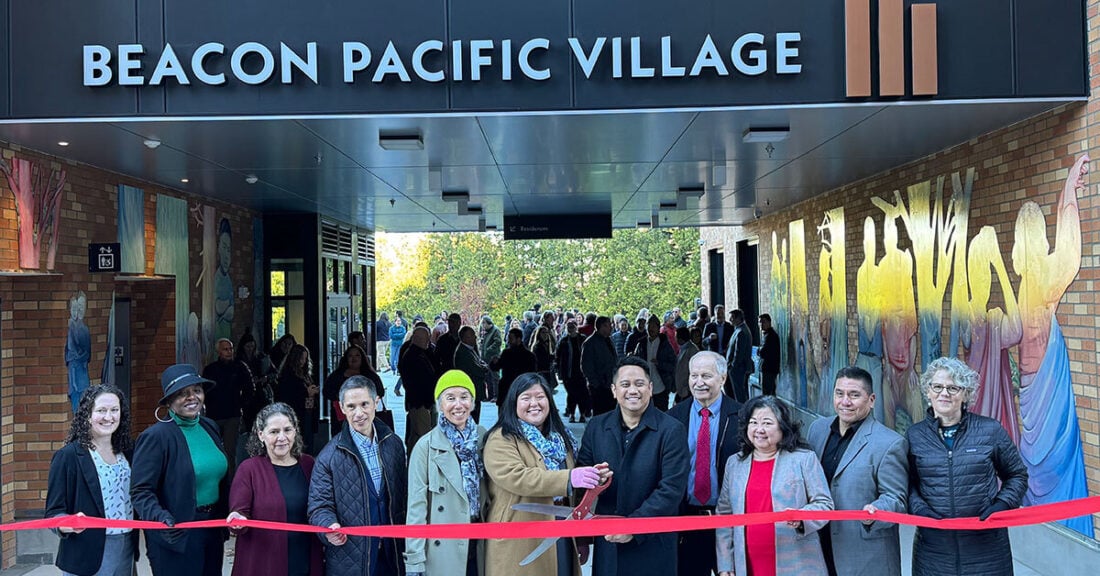
Alice Shobe (far right of photo) at the ribbon-cutting ceremony for Beacon Pacific Village in Seattle, a 160-unit affordable housing community, supported in part with funding from Amazon. Credit: Amazon
Alice Shobe is the global director of Amazon Community Impact, the charitable arm of the multinational technology company. With a career spanning more than 25 years in the public, nonprofit and philanthropic sectors, Shobe has led efforts to address homelessness, equitable community development and other complex social issues. Along the way, she has applied competencies and concepts learned from her participation in the Children and Family Fellowship® — the Annie E. Casey Foundation’s intensive executive leadership program.
“The Casey Fellowship was the pivotal moment of my career,” said Shobe. “The Fellowship tools have really helped me at Amazon, which is always thinking big and thinking at scale. I have been using those skills every step of the way here.”
Helping People Do More Together
Shobe completed her Casey Fellowship while working as director of the Gates Foundation’s Sound Families Initiative, which is a public-private partnership focused on reducing homelessness in Washington’s Puget Sound area. Like other Fellows, she received a thorough grounding in Results Count™, the Casey Foundation’s data-driven approach to helping social-sector professionals achieve better outcomes for children and families.
Results Count taught Shobe about using oneself as an instrument of change — the notion that individuals can lead from whatever position they hold in an organization. “Reflecting on one’s role and authority, leveraging what you can contribute and understanding people’s differences and behaviors in groups was an amazing opportunity for me,” she said.
Shobe also recalls learning about Results-Based Facilitation, the process of designing and contributing to meetings that move groups from talk to action and hold participants accountable for their commitments. “The Results-Based Facilitation part of the Fellowship particularly resonated with me, because it was about helping people do more together,” she said.
As a member of the 2007–2008 class of Casey Fellows, Shobe was able to apply her newly acquired skills to achieve the ambitious goals of the Sound Families Initiative. Once complete, the $40 million project had tripled the number of new housing units available to families emerging from homelessness in Washington’s King, Pierce and Snohomish counties.
Building Changes
Before landing at Amazon, Shobe served as deputy director and then director of Building Changes, a nonprofit intermediary dedicated to addressing homelessness in Washington state. The organization engages in policy advocacy, collaborates with public and private partners, and utilizes informal authority to influence change.
Shobe infused the culture of Building Changes with lessons from Results Count. “I had 100% of my staff go through both results-based accountability and facilitation training,” she said. “This training was core to the kind of work we were doing as an intermediary.”
Under Shobe’s leadership, Building Changes helped to secure a 30% reduction in family homelessness statewide and successfully lobbied for $14 million in legislative allocations for community-based efforts supporting youth and families experiencing homelessness.
@Amazon
Shobe joined Amazon in 2017 as the founding director of the company’s community impact team. With an initial focus on Seattle — the location of the company’s headquarters — as well as the United States, she led a small team that developed five charitable priorities:
- computer science education;
- food insecurity;
- affordable housing;
- disaster relief; and
- a volunteer program for Amazon employees.
Shobe’s emphasis on results and accountability has meshed well with Amazon’s data-driven culture. The company has multiple businesses in many countries — a complexity that has afforded Shobe ample opportunities to use her Results-Based Facilitation skills to build partnerships and drive shared conversations to achieve shared goals.
For example: In the first weeks of the pandemic, many school systems shut their doors and shifted suddenly to remote learning. The Seattle public school system needed to get 8,200 laptops in the hands and homes of students who might otherwise have no other means to keep up with their coursework.
Shobe and her team met with school officials and technical staff from Amazon and the group agreed to shift the school system’s traditional procurement approach — buying expensive, robust laptops that could be recycled among students — to a cheaper alternative: Giving Chromebook laptops outright to kids. As a result of these meetings, Amazon shipped the 8,200 Chromebooks directly to students — a donation valued at $2 million.
Going Global
In 2020, Shobe began expanding Amazon’s community impact work globally. The team’s successes to date include:
- supporting Ukrainian refugee relief in Europe;
- developing a program that has delivered 33 million meals to families facing food insecurity;
- and expanding Amazon’s global disaster relief network to 15 hubs that have distributed 25 million relief items since 2017.
Today, Amazon provides below-market financing and grants to preserve and create affordable housing for low- and moderate-income families. Yet, the company’s record of financing affordable housing only began once Shobe arrived.
To grow Amazon’s expertise in this area, Shobe assembled a team of dedicated financial and legal leaders to collaborate across the company. The team created the program and worked with communities to ensure that their needs were being met.
Amazon has committed $3.6 billion to help preserve and create 35,000 affordable housing units in the Puget Sound region, greater Washington, D.C., and Nashville, Tennessee. Since 2021, the company has created or preserved over 21,000 affordable homes and more than 10,000 in the Puget Sound region.
Results Count Mindset
Throughout her career, Shobe has consistently embodied the Results Count mindset. A water bottle on her desk bears her straightforward leadership approach: “Get stuff done.” This simple reminder reflects her unwavering commitment to accountability, action and achieving meaningful outcomes — principles that have guided her career and created waves of positive change for countless communities.
Read about how results-based facilitation moves groups from talk to action
Learn how fellows collaborated to strengthen financial stability in Minnesota